Why Am I Not Getting Interviews? Causes You Can Check
Not getting interviews? Check three causes in order: it never reached the employer, a screening answer ended it, or it is too early. Here is how to tell.


- Read
- 8min
- Words
- 1,529
From GetMattered
Stop scrolling job boards
Tell GetMattered what you want, swipe through live roles from active employers, and it applies with a resume rewritten for each one. Interviews on your calendar, not rejection emails.
Start getting appliedIf you are not getting interviews, check the causes in order, starting with the ones you can prove. First, find out which applications reached the employer. Next, look at your screening answers, because Greenhouse, Ashby and Workable let an employer reject an application on an answer to the form's own questions. Then give it time: the rejection emails we timed took a median of 7.6 days to arrive. Leave the resume rewrite until those checks are done.
Last checked: 17 November 2026.
Why am I not getting interviews?
Each row below is one cause, a sign you can check this week, and what to do about it. The first three rows need no new resume.
Scorecard
Did my application reach the employer?
A click on Submit does not prove that the employer received your application. A form can fail a check after the click, or stop to ask for a code from your inbox.
The sign to look for is the employer's confirmation email. Across the confirmation emails our agent received this autumn, half came within 31 seconds of the final submit click, and most came within five minutes. If an hour passes with nothing, check your spam folder and the employer's candidate portal. Some employers switch the email off, so a missing email alone does not prove a failure. Our guide on checking whether an application went through covers each hiring system.
For our own count, we use the employer's proof. Use the same rule on your list. An application you cannot confirm does not count toward your total.
Did a screening answer reject me?
It is possible, and you might never be told. Greenhouse says its "Auto-Reject uses custom application questions to screen and reject candidates based on their responses". On Ashby, auto-reject rules run "at the point of the candidate's application submission", and the rejection condition "is based on application questions".
Workable says what the candidate sees. When a candidate answers No to a knock-out question, "they will still receive an application confirmation email", and the candidate does not know that they have been disqualified. So a confirmation email proves the application arrived, and a person may still never read it.
These questions are common on the forms we fill. Our agent records the label of each field on a form. On the forms it filled for real users between 17 August and 16 November 2026, 58% asked about work authorization or sponsorship.
Our data shows which questions a form asked. It cannot show which employers put a rule on the answer, so read that count as how often the risk comes up.
What to do:
- Read each yes or no question twice. "Will you now or in the future require sponsorship?" asks something different from "Are you authorized to work in this country?"
- Answer truthfully. If you will need sponsorship, spend your applications on employers that offer it.
- Keep one note with your standard answers on work authorization, sponsorship, location and pay, so every form gets the same answer.
Is it too early to hear back?
Often, yes. We timed the rejection emails that reached our users' GetMattered Inbox for applications sent between 17 August and 2 October 2026, and counted them on 2 November. The median rejection came 7.6 days after applying. About half came after the first week, and a few took more than 30 days.
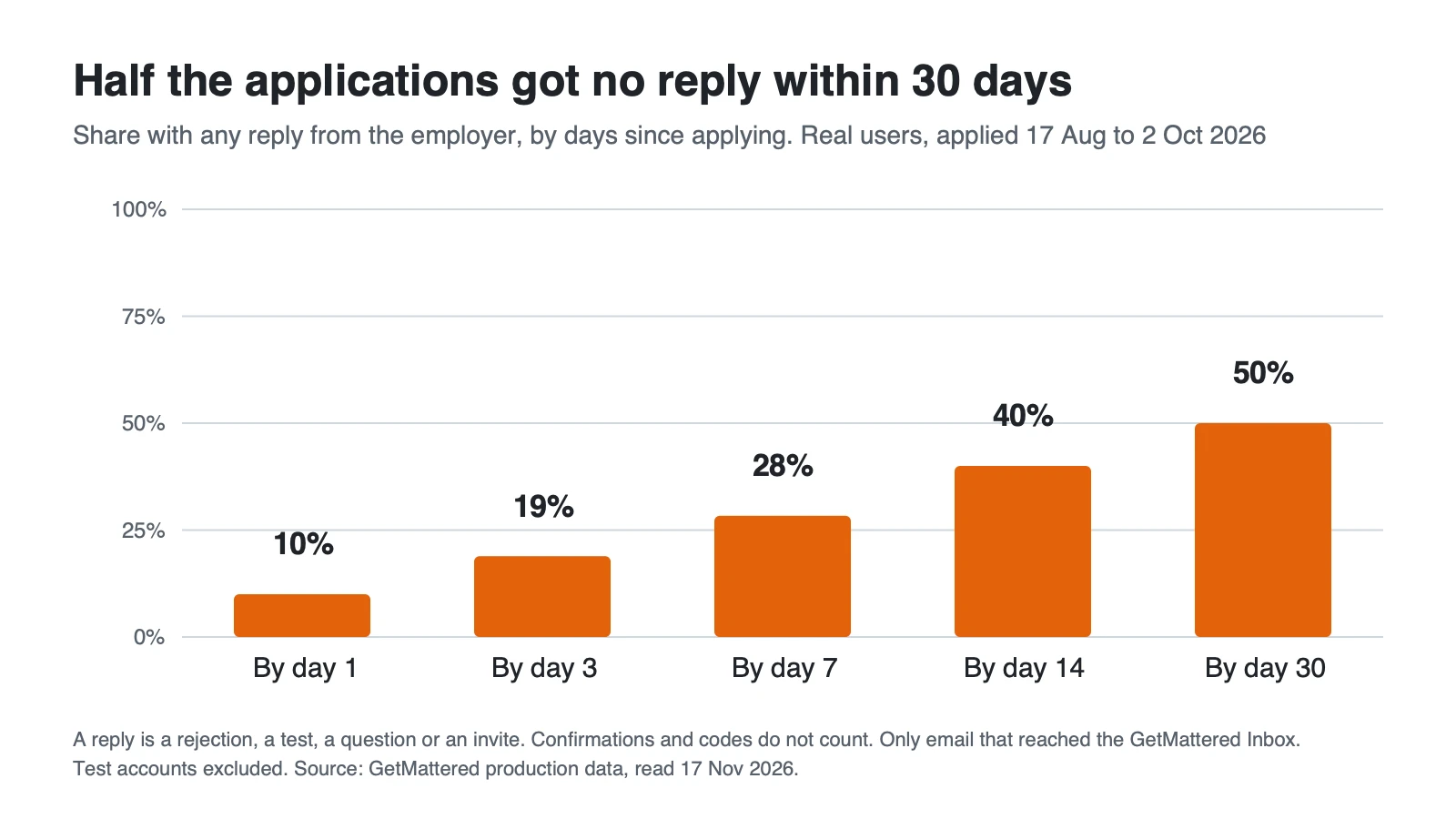
Half of the applications got no reply at all within 30 days. On 17 November 2026 we read the same window again and counted any reply from the employer, such as a rejection, a test, a question or an invite. Confirmations and inbox codes do not count. Of the applications our agent submitted, 40% had a reply by day 14 and 50% by day 30.
Some rejections stay silent for longer. On Workable, a candidate rejected by a knock-out question hears nothing until the employer chooses to write. By day 14, about three in four of the rejections we timed had arrived. That makes two weeks a fair point to read silence as a probable no and send one short follow-up. Our guide on how long it takes to hear back breaks the wait down by hiring system.
Why am I not getting interviews for jobs I'm qualified for?
The employer interviews only a few of the people who apply. Greenhouse's fall 2026 Hire Standard report covers 161.8 million applications across 9,473 companies, from January to August 2026. "Of every 1,000 applications, only 32 ever reach a first interview", it says, and "one in three openings closes with no one hired at all". So some silence has nothing to do with your application.
In a pile that size, your resume has to show the fit fast. Huntr's Q2 2026 report is built from applications its users tracked themselves. In it, applications with a tailored resume had a 5.71% recorded interview rate, against 3.09% without one. Huntr asks readers to "treat comparisons as descriptive associations, not causal estimates", so this shows a pattern and does not prove that tailoring caused the interviews.
What to do: put the posting's job title and its main skills near the top of your resume, where they are true for you. Never add work you did not do.
Are you applying in the right place?
Where you click Apply can matter. Huntr's Q3 2026 report compared the same people across their own applications. For 5,855 job seekers who used both, employer career sites had a 6.2% interview rate, against 4.9% for job boards. Like Huntr's other comparisons, it is an association.
What to do: when you find a job on a board, look for the same posting on the company's careers page and apply there.
I applied to hundreds of jobs and got no interviews. What now?
Others report the same thing. On r/cscareerquestions, a 1 November post titled "Tech leader, over 600 applications since Sept 1, zero offers" drew 490 comments. On r/jobsearchhacks, a 13 November post asked for help with "A lot of applications and ZERO selections everywhere".
Volume alone does not explain it. Huntr compared the same 4,456 job seekers across their own weeks, from January 2025 to September 2026. In weeks when they sent 3 or more times their usual number of applications, their interview rate fell from 9.5% to 5.6%, and their interviews per month rose from 0.7 to 2.9. In that data, more applications brought more interviews at a lower rate.
So audit before you change anything. Take your last 50 applications and count:
- how many have a confirmation from the employer;
- how many have screening answers you would give again word for word;
- how many are at least 14 days old, the only ones you can judge yet;
- how many went out with a resume changed for that posting;
- how many you sent on the employer's own site.
How to get more interviews
Start with the lowest count from that audit, since it shows the check you have skipped most. Fix that one, keep your pace steady, and run the audit again after the next 50.
How GetMattered handles these checks
GetMattered is the end-to-end AI auto-apply platform: it finds the job, tailors your resume, handles the employer account and email check, and submits on the employer's own hiring system. It counts an application as sent only when the employer confirms it, and the confirmation stays next to the application, so the first check on this page is already done for you. It fills each form's own questions from your profile and resume. It cannot make a recruiter call you, and we do not publish an interview rate. The auto-apply page shows each step, and our post on whether auto-apply tools work shows how we count confirmed applications.
The short version
Count only the applications the employer confirmed. Check your answers to the yes or no screening questions, because a rule can end an application on one answer. Give each application two weeks, since the rejections we timed took a median of 7.6 days. Then make the resume show the fit for each posting, and apply on the employer's own site.
How we made this
This post was drafted with AI help. The outside sources were read on 17 November 2026, headless, and each quote was matched against the saved page text. The reply counts and the screening question counts come from GetMattered's production database, read on 17 November 2026. The rejection times and the confirmation email times come from our count on 2 November 2026, published in the posts linked above. All of our numbers cover real users only, with test and staff accounts excluded. We read field labels, email types and timestamps, never the answers people gave or the text of an email. We only see emails that reach the GetMattered Inbox, so a rejection sent another way is not counted.
About the author
Ava Bagherzadeh is the founder of GetMattered. She builds it on her own from Germany, including the agent that fills in job applications and the checks that confirm each one reached the employer.