Do Auto-Apply Tools Work? What 392 Applications Showed
We checked 392 applications our agent sent: 383 have proof from the employer's side. What auto-apply does well, the LinkedIn risk, and what to check first.


- Read
- 7min
- Words
- 1,084
From GetMattered
Stop scrolling job boards
Tell GetMattered what you want, swipe through live roles from active employers, and it applies with a resume rewritten for each one. Interviews on your calendar, not rejection emails.
Start getting appliedThey work when they do three things: submit on the employer's own hiring system, prove that each application landed, and stay away from your LinkedIn account. We checked every application our agent sent for real users between 17 August and 31 October 2026. Of 392, the employer's side confirmed 383. Interviews are a separate question. In Huntr's 2026 data, tailored applications sent on the employer's own site were marked interviewed more often.
Last checked: 2 November 2026.
What do people mean by "does it work"?
Read the threads and you find three different worries. One post on r/recruitinghell is titled "Hoping to help job seekers: DO NOT use auto apply services/sites" (14 October, 77 comments). Another, on r/jobsearchhacks, asks "Has anyone actually landed a job using an AI auto-apply tool, or is it all hype?" (24 October).
Underneath, people ask:
- Will it get my LinkedIn account banned?
- Does it actually submit the application?
- Does it get me interviews?
Will an auto-apply tool get my LinkedIn account banned?
It can, if the tool runs inside LinkedIn. LinkedIn does not permit "any third party software, including "crawlers", bots, browser plug-ins, or browser extensions" that automate activity on its site. Members who use them "risk having their accounts restricted or shut down" (LinkedIn Help). Section 8.2 of the User Agreement also bans "bots or other unauthorized automated methods to access the Services". And LinkedIn now puts "daily and speed limits on Easy Apply submissions" (LinkedIn Help).
So a browser extension that clicks Easy Apply for you all day is working against LinkedIn's own rules, with your account on the line.
A tool that applies on the company's careers site is a different setup. It finds the job, then fills in the employer's own form on Greenhouse, Workday, Lever or wherever the company hires. Your LinkedIn login never comes into it. GetMattered works this way: our code refuses LinkedIn Easy Apply outright and applies only on the employer's own hiring system.
Does auto-apply actually submit the application?
Pressing a submit button is easy. Knowing the employer received the application is harder, because a form can fail validation, ask for an email code, or bounce you to a login page after the click.
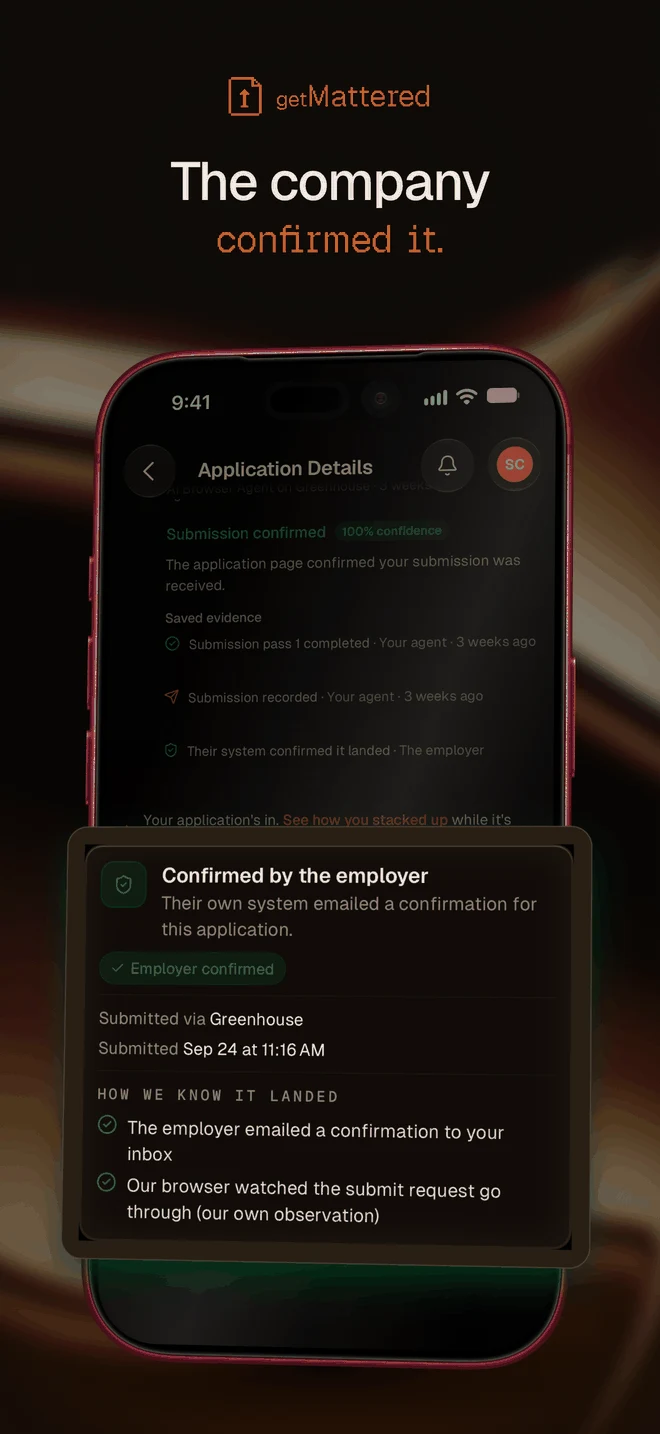
So the honest test is proof from the employer's side. We count an application as landed when we have one of three things: the employer's own confirmation email, a success answer from the employer's own server, or the employer's thank-you page read and quoted by our checker.
Scorecard
And by system, for the eight we used most:
Scorecard
Not every employer sends a confirmation email, so a missing one is not always a failure. That is why the other two kinds of proof count. If a tool cannot show you any of the three for an application, treat that application as unconfirmed.
How much time does auto-apply save?
We can only measure our agent's time, not yours. From opening the form to a confirmed submission, our agent took a median 6.1 minutes per application (n = 384). Across those applications that adds up to 46.4 hours of form filling that 14 people did not have to do. Workday forms took longest, at a median 8.5 minutes.
From the moment GetMattered started preparing an application to the moment it was submitted, the median was 10 minutes, and 224 of 392 went out within 15 minutes.
Does auto-apply get you interviews?
It depends on what you point it at. No tool can make a recruiter call, and we are wary of any tool that quotes you an interview rate without saying how it was counted.
We do not publish one from our own data yet. We only see replies that reach the application inbox, and a recruiter who phones you or writes to your personal address never shows up there. A rate built on that would undercount.
The largest public dataset we found is Huntr's Q2 2026 report, built on applications its users tracked themselves. Three patterns in it matter here:
Scorecard
Huntr is careful to call these associations, not causes, and says its interview flags are "likely incomplete". It also says the volume pattern "does not show the effect of sending fewer applications" (Huntr).
The direction is still useful. The applications that did better were tailored and sent on the employer's own site. That is what you want an auto-apply tool to do, for jobs you would actually take. Sending 200 generic applications a day is the opposite of both.
One more trap: screening questions. Greenhouse lets employers set Auto-Reject rules that "screen and reject candidates based on their responses", for example to a visa question (Greenhouse). A tool that answers those questions carelessly can get you rejected in seconds. Check what yours answers.
What should I check before I pay for an auto-apply tool?
Scorecard
How GetMattered handles auto-apply
Here is how each line of that checklist works in GetMattered.
- You pick jobs in Discover by swiping right. Left swipes and saves are free.
- Resume rewriting rebuilds your resume for that posting from your real history. A cover letter is written only if the form asks for one.
- Auto-apply fills the employer's own form on their hiring system. If the system wants an account, the agent creates one and verifies the email itself. It works on 34 hiring systems, 30 of them live today.
- An application counts as sent only when the employer's side confirms it. The receipt sits next to the application in Applications, and the employer's emails come to your Inbox.
- You set the control level: approve each application, swipe right to send, or turn on Auto Apply on the top plan and let it run.
Plans and limits are on the pricing page. If you are comparing tools, our comparison of auto-apply tools puts the main options side by side.
How we made this
This post was drafted with AI help. Every outside fact links to its source, and each one was checked against that page on 2 November 2026, twice. Our numbers come from GetMattered's production database, read the same day. They cover real users only, between 17 August and 31 October 2026; test and staff accounts are excluded. Fourteen people is a small group, so read our numbers as what happened for them.
About the author
Ava Bagherzadeh is the founder of GetMattered. She builds it on her own from Germany, including the agent that fills in job applications and the checks that confirm each one reached the employer.