What to Put for Salary Expectations on an Application
For salary expectations on an application, type one round number from the middle of your range. Why a 0 can cost you the interview, and which laws apply.


- Read
- 7min
- Words
- 1,126
From GetMattered
Stop scrolling job boards
Tell GetMattered what you want, swipe through live roles from active employers, and it applies with a resume rewritten for each one. Interviews on your calendar, not rejection emails.
Start getting appliedTyping 0 in the salary expectations box feels like a clever dodge. To the hiring system, 0 is your answer.
Here is what to type instead. First check whether the posting lists a pay range, because in many US states, the EU and Ontario it now has to. Then type one round number from the middle of the range you would accept, digits only, with no dollar sign and no commas. Write "negotiable" only in a text box that is optional, and leave the box blank only when it is not required.
How often does a job application ask for your desired salary?
Often enough that you need a plan. We logged every field our agent filled on 390 applications it sent for real job seekers between 17 Aug and 31 Oct 2026 (test accounts excluded).
- 175 of the 390 forms (45%) asked about pay.
- 99 of those 175 marked the question as required.
- 24 asked for a range, and 56 named the unit, such as annual, hourly, base or gross.
- Only 1 asked what the candidate earns now. Almost all the others asked what the candidate expects.
It depends on the system. Workday forms asked in 45 of 83 applications and Greenhouse in 37 of 104. Personio forms asked in 14 of 17, usually as "Gehaltsvorstellung", German for salary expectation. On Workday, that question sits behind an account for each employer.
Can an employer reject you for your salary expectations?
Sometimes, and it depends on the question type more than the number. Greenhouse lets employers auto-reject candidates from their answers to custom questions, but only on Yes/No, single-select and multi-select questions. A number you type into an open box cannot trip a Greenhouse auto-reject rule by itself.
The question that can is the multiple-choice version. A pay-band dropdown or a yes/no like this one, from a real form in our logs: "The base salary range for this position is $90,000–$105,000, depending on experience and qualifications. Does this range fall within your salary expectations?" Answer "No" there and an employer rule can reject you before a person reads anything. We looked at how tools answer these questions in do auto-apply tools work?
Workable works like Greenhouse here. Its knock-out questions are Yes/No only, and Workable notes that "the candidate does not know that they have been disqualified." Ashby goes further. It lets employers auto-reject candidates on typed answers too, with conditions such as "Equals", "Contains" and "Is empty/unassigned". On an Ashby form, a 0 or a blank box can match a rule. So a stated range you can live with deserves a "Yes", and a real number beats a placeholder everywhere.
Does the job posting have to show the salary?
In a growing number of places, yes. Check this before you type anything, because the posted range tells you where your number should sit.
Scorecard
In the EU, the Pay Transparency Directive says job seekers must learn the starting pay or range "in the vacancy notice or ahead of the interview". Member states had until 7 June 2026 to write it into national law, so whether it binds an employer depends on that country's own law.
If a covered employer posts no range, you can still answer the question. You just have less to go on, so lean on your own research.
Can they ask what I earn now?
In many places, no. California's Labor Commissioner says employers cannot "seek salary history information", and the same FAQ says nothing stops them from asking about your salary expectation for the role (California Equal Pay Act FAQ). New York's Labor Law 194-a bars employers from asking you for your wage history. Colorado and Virginia ban it too, and the EU directive tells employers not to ask about pay history at all.
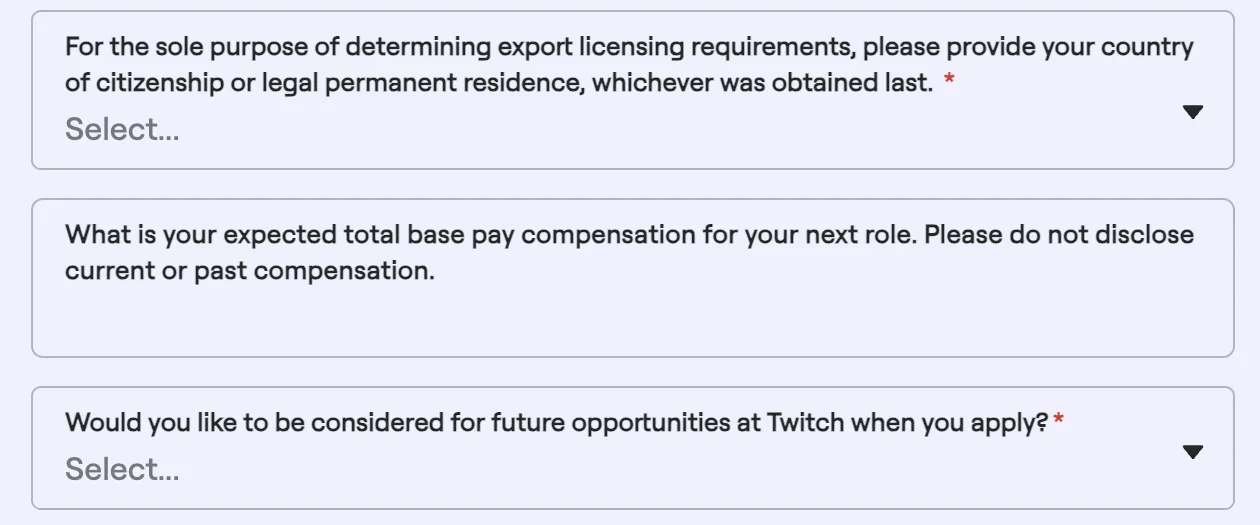
Some forms say it in the question itself. A Twitch posting for an Applied Scientist in San Francisco, on Greenhouse, asks for your expected base pay and adds "Please do not disclose current or past compensation." That box has no red star, so it is optional.
What should I put for salary expectations on an application?
- Find the range you would accept for this role, in this location, using the posted range if there is one and salary data for the title if there is not.
- Take a round figure from the middle of it. Typing your floor tells them the least you will take. Typing your ceiling can put you above their range.
- Match the unit the question names: annual or hourly, base or total, and the currency. On 56 of the 175 forms that asked about pay, the question named the unit, so read the label twice.
- Type digits only, like
95000. A number field rejects anything that is not a number (MDN), so$95,000or "negotiable" can block the whole form. - If the question offers a range check with a range you can accept, answer "Yes".
Should I put 0 or negotiable for desired salary?
Not in a required box. The form saves a 0 as your answer, and on Ashby a 0 can match an auto-reject rule. Leaving it blank or writing "negotiable" is fine only in an optional text box. A required field will not let you submit until you type something.
How GetMattered fills the salary box
You save your salary range once in your job preferences. When a form asks for one number and you saved both ends of your range, the GetMattered agent types a single round figure from the middle of it, never your floor and never your ceiling. It enters bare digits, so number-only fields accept it, and it reads the currency from the same saved preference, so a euro range does not turn into dollars.
The salary box is one of the screening questions the agent answers on the employer's own form, along with the dropdowns and yes/no checks that decide whether a person ever sees you. Then it waits for the employer's system to confirm the application before counting it as sent. See how auto-apply works.
Last checked 2 Nov 2026. Pay transparency laws change often. Re-check the table on publish day.
About the author. Ava Bagherzadeh is the founder of GetMattered. She built its auto-apply agent and the checks that confirm each application landed. She builds it alone, from Germany.
How we made this
Drafted with AI help. Each law links the statute or an official government page, and every source was checked twice on 2 Nov 2026. Our numbers come from GetMattered's production database, read on 2 Nov 2026, with test accounts removed. The form screenshot comes from a public Greenhouse posting, opened on 13 Nov 2026. This post is general information, not legal advice.