LinkedIn Easy Apply vs Company Website: What Recruiters See
Easy Apply can land in the employer's ATS or stay inside LinkedIn. Where each path goes, what the recruiter sees, and which one saw more interviews.


- Read
- 6min
- Words
- 1,035
From GetMattered
Stop scrolling job boards
Tell GetMattered what you want, swipe through live roles from active employers, and it applies with a resume rewritten for each one. Interviews on your calendar, not rejection emails.
Start getting appliedEasy Apply is worth it for a quick first try at a job you just spotted, or at a small company with no careers page. For a job you really want, apply on the company's own website. The reason is a setting you cannot see. If the employer has connected its hiring system to LinkedIn, your Easy Apply lands in that system, marked as coming from LinkedIn. If it has not, your application stays inside LinkedIn's own applicant list. Applying on the company's careers page always writes straight into their system. In Huntr's 2026 data, career-site applications were also marked interviewed more often. Huntr adds that the data can't show the route caused it.
Last checked: 2 November 2026.
Where does a LinkedIn Easy Apply application go?
LinkedIn's own wording is that "your application is securely sent to the job poster" (LinkedIn Help). Where the poster reads it depends on how the job was posted. LinkedIn lets posters collect applicants on LinkedIn or "route candidates to an external website" (LinkedIn Help).
Scorecard
When it stays inside LinkedIn, the poster opens the job post and clicks View applicants. They can sort by "applicant fit rating" and filter out applicants "who do not meet your screening qualifications" (LinkedIn Help). If the job was posted from someone's personal LinkedIn account, "bulk downloading or exporting applicant profiles is not available" (LinkedIn Help).
What is LinkedIn Apply Connect?
Apply Connect is the link between an employer's hiring system and LinkedIn. LinkedIn's developer docs describe it as an integration that lets members apply on LinkedIn "without being redirected to external websites", while the employer's system receives "all job applications directly" (LinkedIn docs). The employer turns it on inside their ATS (LinkedIn Help).
Greenhouse is a good example of how it works in practice (Greenhouse):
- Easy Apply applicants become candidate profiles in Greenhouse, with "LinkedIn" as their source.
- It costs Greenhouse customers nothing extra, but it "has to be enabled on each job".
- Since July 2025, free Apply Connect posts have a cap on Easy Apply applications. Once the cap is hit, new applicants are sent to the employer's career site instead.
So two people who click Easy Apply on the same company's jobs can end up in different places, and neither can tell from LinkedIn.
What does the company website ask that Easy Apply might not?
The careers page runs the employer's own form, with every question they set. We looked at the fields our agent filled in 390 applications on employers' own hiring systems for real users this autumn. One question kept showing up.
Scorecard
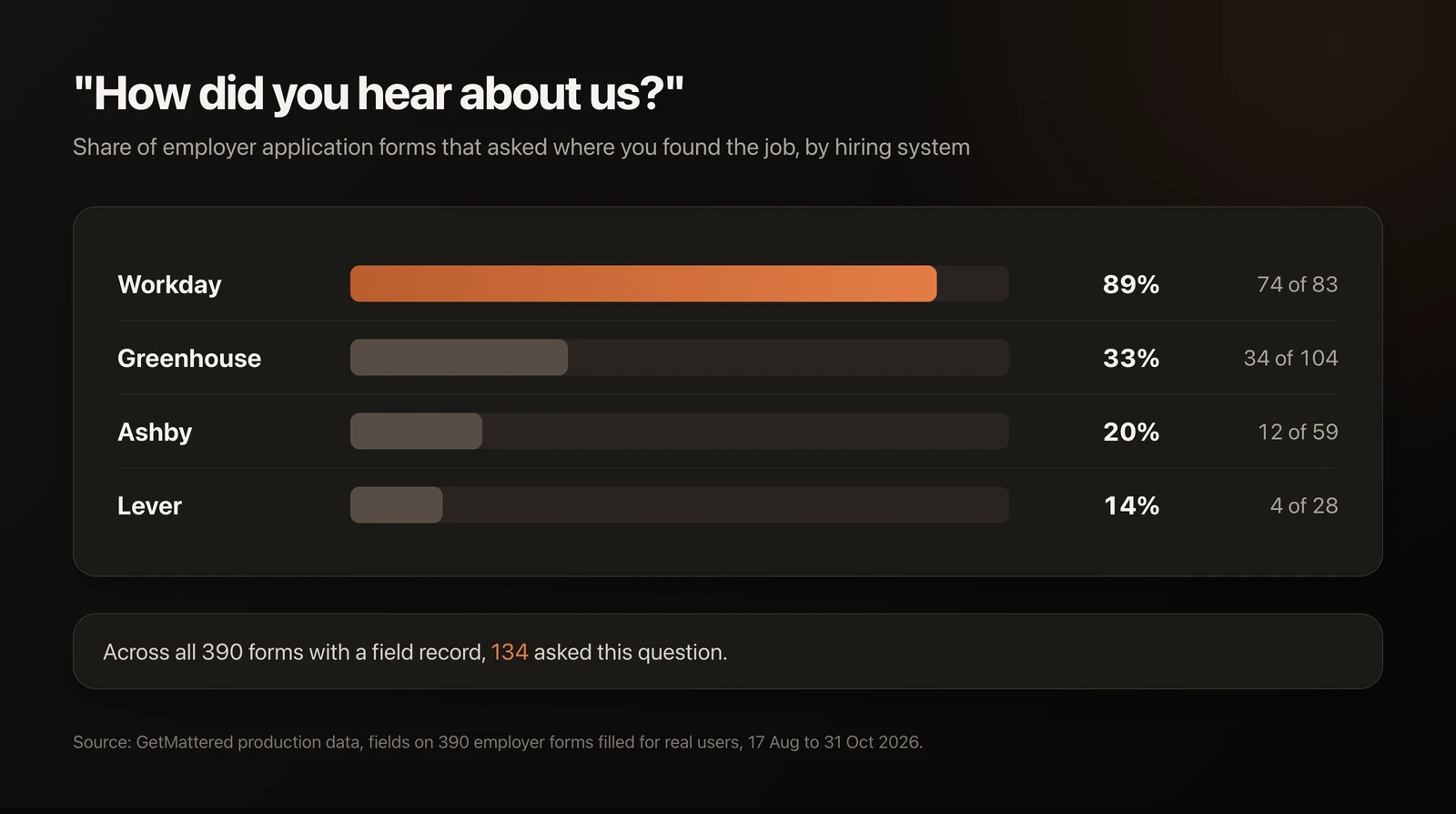
Answer it truthfully: if you found the job on LinkedIn, say LinkedIn. The careers page also carries the employer's full set of screening questions, which is where automatic rejection rules sit (we covered those in do auto-apply tools work?).
One more difference shows up later. Greenhouse's candidate portal, MyGreenhouse, warns that "applications submitted through LinkedIn, Indeed, or other third-party sites may not appear" there (Greenhouse). An application made on the company's own Greenhouse page is the one most likely to show up there. Our guide on checking whether an application went through covers MyGreenhouse and the other portals.
Does applying on the company website get more interviews?
The best public numbers we found lean that way. Huntr's Q2 2026 report grouped applications its users tracked by the route they took (Huntr):
Scorecard
Over the trailing twelve months, Huntr also reports 3.36% for applications sourced through linkedin.com and 7.91% for the 1,630 sourced through google.com.
Huntr is clear that these "are descriptive rates, not route effects". People who go to the careers page may be the ones who fit better or try harder. Still, nothing in this data says Easy Apply does better, and the careers page removes the doubt about where your application went.
Should I apply on both LinkedIn and the company website?
It is a common question. One r/jobsearchhacks post asked "How do you track the same job application when applied from different places (Eg LinkedIn and Company Website)" (25 October). Our suggestion is to pick one, and make it the company site when there is one. If the employer uses Apply Connect, both applications can end up in the same ATS. If they do not, the careers-page application is the one in their system anyway.
The big October thread on this, "Has anyone actually had better results applying directly through company websites instead of LinkedIn?", drew 135 comments. Easy Apply is fine for a quick first move on a job you just spotted. For the jobs you care about, the company site gives you a record you can check.
Quick guide: which way to apply
Scorecard
How GetMattered handles this
GetMattered only ever applies on the employer's own hiring system. Our code refuses LinkedIn Easy Apply, so the agent never works inside your LinkedIn account. That keeps it clear of LinkedIn's ban on bots and extensions that automate activity on its site (LinkedIn Help).
- In Discover you swipe right on jobs, wherever we found them.
- Auto-apply follows the job to the employer's own form on one of the 30 hiring systems we support, among them Workday, Greenhouse, Lever and Ashby. It fills the whole form, screening questions included.
- The application counts as sent only when the employer's side confirms it. That receipt sits in Applications, and the employer's replies come to your Inbox.
If you are weighing tools that apply for you, our comparison of LinkedIn auto-apply tools explains which ones run inside your LinkedIn account and which do not.
How we made this
This post was drafted with AI help. Every outside fact links to its source, and each one was checked against that page on 2 November 2026, twice. Our numbers come from GetMattered's production database, read the same day, for real users only between 17 August and 31 October 2026; test and staff accounts are excluded. The count of 30 hiring systems comes from our code, read on 17 November 2026.
About the author
Ava Bagherzadeh is the founder of GetMattered. She builds it on her own from Germany, including the agent that fills in job applications and the checks that confirm each one reached the employer.